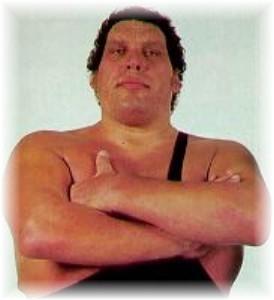
Real Name - Andre Roussimoff Aliases - Butcher Roussimoff; Giant Roussimoff; Monster Roussimoff; Eiffel Tower; Monster Eiffel Tower; Jean Ferre; Geant Ferre, Giant Machine Hometown - Coulommiers, France Debuted - 1970 Titles Held - NWA Australian Tag Team (with Ron Miller); NWA Florida Tag Team (with Dusty Rhodes); IPW World Tag Team (with Michael Nader); NWA United States Tag Team (with Dusty Rhodes); WWF World; WWF World Tag Team (with Haku) Other Accomplishments - Winner of PWI Most Popular Wrestler of the Year award in 1977 and 1982; Winner of PWI Match of the Year award in 1981 (vs. Killer Khan); Winner of Wrestling Observer Newsletter Feud of the Year award in 1981 (vs. Killer Khan); Winner of PWI Most Hated Wrestler of the Year in 1988; Winner of PWI Match of the Year award in 1988 (vs. Hulk Hogan); Recipient of PWI Editor’s award in 1993; Inducted to WWF Hall of Fame in 1993; Member of Stampede Wrestling Hall of Fame; Inducted to Wrestling Observer Newsletter Hall of Fame in 1996; Ranked #3 of the Top 500 Singles Wrestlers of the PWI Years by Pro Wrestling Illustrated in 2003
Andre was a man born with acromegaly, a disease that essentially causes extremities enlargement through a release of excess growth hormone. As he continued to grow larger than most normal men he became a sight to behold. In the 1960s he was discovered by Lord Alfred Hayes and was trained to be a wrestler in France. In the early ‘70s, French-Canadian Edouard Carpantier brought Andre to North America, but his size caused him to run out of plausible opponents in a hurry.
Once the McMahon family got a hold of him in the mid ‘70s, they transferred him into a traveling attraction, never staying in one spot too long so as to not wear out his welcome. He specialized in 2 or 3-on-1 handicap matches and battle royals that showcased his size and ability in a spectacle setting.
By the time Vince McMahon, Jr. began his national expansion in the early ‘80s he kept Andre as an exclusive North American property of the World Wrestling Federation, while allowing him to continue his international commitments. He was one of the company’s top babyfaces through the first half of the ‘80s, having memorable feuds with Killer Khan (that was highlighted by a Mongolian Stretcher match) and the “true giant of wrestling” battle with Big John Studd that was highlighted by the WrestleMania I bodyslam match. He followed that up with a big win at WrestleMania 2 in the NFL-WWF co-branded twenty man battle royal, last eliminating Bret Hart.
But it was in 1987 when things really got good. After he turned on Hulk Hogan for essentially being a glory hound, the stage was for the biggest match in wrestling history – Hulk Hogan versus Andre the Giant for the WWF World Heavyweight Championship. When people say this was the biggest match in history, for once it wasn’t hyperbole. Hogan and Andre legit sold out Pontiac Silverdome to a tune of anywhere from 79,000 – 93,173 fans (depending on who you ask or believe.) Andre did the honors for Hogan that night, taking the pin after a bodyslam and a legdrop. The match itself was atrocious, but for historical purposes it is a must-see. Andre had successfully passed the torch to Hogan. His health was quickly deteriorating, and he was ready to fade into a part-time spot.
He spent the rest of ’87 and into ’88 feuding with Hogan. He and Hogan captained five man teams at the inaugural Survivor Series on Thanksgiving night 1987. Andre was the sole survivor in that ten man elimination match, that led to him receiving a WWF Championship rematch live on NBC in February ’88. Thanks to the “twin Hebner referees” and a fast count, Andre won the belt. He immediately surrendered the belt to “Million $ Man” Ted DiBiase, which then caused the belt to be vacated and put up in a tournament at WrestleMania IV. Andre and Hogan had another rematch in the quarter finals of the tournament, but were both disqualified. Andre continued to feud with Hogan through the first half of ’88 before transitioning into feuds with other top card babyfaces like Randy Savage, Hacksaw Jim Duggan and Jake “The Snake” Roberts. He also was called upon to put over The Ultimate Warrior during the second half of ’89 through a series of 30 second long house show matches. By this point his health had gotten so bad that he could no longer work a full match and these short spots were done for both men’s benefits.
His last hurrah in the WWF was when he and Haku won the WWF World Tag Team Championship from Demolition in early 1990. It allowed Andre to still seem like an active competitor without having to work much of a match, and the title reign was probably a little “thank you” from the company for all of Andre’s years of service. After he and Haku dropped the belts back to Demolition at WrestleMania VI, Andre turned on his manager Bobby Heenan and his partner and left the ring a babyface. It was the last time he would wrestle in a WWF ring.
Andre made appearances with the WWF through 1990 and ’91 as face on-air personality. He traveled to Japan in 1992 and briefly teamed Shoechi “Giant” Baba as a superstar tag team. His last public appearance was a brief interview on the WCW Clash of the Champions XX special held on the September 2, 1992.
He died on January 27, 1993, in a Paris, France, hotel room while there for the funeral of his father. He was 46 years old.
Because of his illness he knew his time wouldn’t be long on this earth so he lived every day to the fullest; eating, drinking, laughing and being around the people he cared about the most, as he knew any day it could come to an end. His size and the pain it caused him physically and mentally definitely wore on him, but outwardly he just wanted him and those around him to always be having a good time. Andre was and is a true pioneer in the wrestling business, especially now in a time when phrases like “legend” and “Hall of Famer” get thrown out with reckless abandon. He was the first member of the WWF Hall of Fame, inducted posthumously in 1993, and set the bar high (pardon the pun) for what it means to be Hall of Fame worthy. He is and always be the prototype and measuring stick for any “super heavyweight” wrestler who comes down the pike. Who else could get away with being called “The Eighth Wonder of the World?”
Quote:
20. DYNAMITE KID
Real Name - Thomas Billington Hometown - Manchester, England Debuted - December 24, 1975 Titles Held - All Japan All Asia Tag Team (with Johnny Smith); British Welterweight ; British Lightweight; European Welterweight ; NWA Pacific Northwest Heavyweight; NWA Pacific Northwest Tag Team (With the Assassin); NWA International Tag Team (4x - 1 with Sekigawa, 1 with the Loch Ness Monster, 1 with Kasavudo, 1 with Duke Myers) ; Stampede British Commonwealth Mid-Heavyweight (5x); Stampede International Tag Team (2x, with Davey Boy Smith); Stampede North American Heavyweight; Stampede World Mid-Heavyweight (4x); WWF World Tag Team (with Davey Boy Smith); WWF Junior Heavyweight Other Accomplishments - Winner of Wrestling Observer Newsletter Best Flying Wrestler award in 1984; Winner of Wrestling Observer Newsletter Best Technical Wrestler award for 1984 (tied with Masa Saito); Winner of Wrestling Observer Newsletter Match of the Year award for 1982 (against Satoru Sayama); Winner of Wrestling Observer Newsletter Most Underrated Wrestler award in 1983; Winner of Wrestling Observer Newsletter Tag Team of the Year award in 1985 (with Davey Boy Smith); Inducted to the Wrestling Observer Newsletter Hall of Fame in 1996; Member of the Stampede Wrestling Hall of Fame; Ranked #5 by Pro Wrestling Illustrated on the 2003 list of the Top 100 Teams of the PWI Years (with Davey Boy Smith)
By most accounts he was a miserable, mean-spirited prick to those outside the ring, but by all accounts he was one of the best athletes to ever step foot inside the ring. He is regarded by virtually anyone who matters as a top five in-ring performer of all time. That’s a lot of praise for a guy who hasn’t been in the ring regularly for over fifteen years.
Just back in April I finally got a chance Dynamite’s autobiography Pure Dynamite. It has been out for years, and was published before the glutton of WWE-created books made it the cliché thing to do, so by the time I finally got a chance to delve into it, all the horror stories and juicy details had already been spread across the Internet. So I already had an idea of what I was getting to into. It turns out he can be an ass in real life, but there aren’t many who worked any harder than he did when he was inside that ring. He literally gave his body to the industry. And even though it was through his own doing from a combination of steroid and drug abuse and his insistence to take unnecessary bumps night in and night out, it’s a fact that shouldn’t be forgotten.
Dynamite Kid grew up in England; a typical hothead youth who would get into playground fights that eventually led to him taking up boxing and wrestling in high school. By 1975 he had made his debut as a professional under the guidance of Ted Betley. He picked up local Championships in his early days, but his career really took off in 1978 when he moved to Calgary, Alberta, Canada to work for Stu Hart.
He spent his time working closely with the Hart brothers, especially Bret, who became essentially his contemporary. Stu Hart had established a working relationship with New Japan Pro Wrestling in 1980 that allowed Dynamite and Bret to make tours of Japan on a regular basis. It was there where Dynamite really poured the cement for his legacy. He began working with a young Japanese wrestler named Satoru Sayama, who would become known as Tiger Mask. The pair absolutely revolutionized the junior heavyweight style of wrestling, putting on matches that were unheard for that time. Dynamite’s pride and stubbornness wouldn’t allow him to have a bad match, and Sayama was right there to keep up with him. Twenty years later these matches are still regarded as classics.
Soon Dynamite’s young cousin Davey Boy Smith came up in the business and began working with Dynamite in Canada and Japan. By 1984, Stu made an agreement with the World Wrestling Federation that would allow his best talent, namely Dynamite, Davey Boy and Bret Hart work for the company. It wasn’t long before Dynamite and Davey, now known as The British Bulldogs, were tearing up the bottom of the cards with matches against Bret and Jim Neidhart, now called The Hart Foundation. Their talent couldn’t be ignored and soon the teams were fighting over the WWF World Tag Team Championships.
Unfortunately Dynamite suffered a serious injury in late ’86 that caused him take some time off while Davey Boy defended the Titles on the house show loop with various partners. When the canned TV squashes had run out, Dynamite had to make his return to drop the belts to The Hart Foundation. He was still in such bad shape that Davey literally had to carry him to the ring. The pair returned later in 1987, now with the addition of a real life bulldog Matilda as their mascot. They never reached the heights they had gained before, and Dynamite’s backstage behavior and antics earned him more than his share of enemies. His now infamous fist fight with Jacques Rougeau led to the Bulldogs leaving the WWF immediately after Survivor Series ’88. The story goes that The Rougeaus were eliminated first from the big ten team elimination match that night, and The Bulldogs were kept in until the final four teams so that no altercation would happen between the two pairs.
Dynamite and Davey went back to working for both Stampede in Canada and All-Japan. It turned sour when Davey abruptly pulled the duo from the 1990 All-Japan World Tag League so he could head back to the WWF as the now trademarked “British Bulldog” Davey Boy Smith. Dynamite kept working in Japan, teaming with Johnny Smith as The British Bruisers, but his relationship with Davey from that point on was unequivocally ruined.
Soon Dynamite’s combination of steroids, recreational drugs and high-impact wrestling style caught up with him and he retired from full-time active competition in 1991. His final match was at a Michinoku Pro event in 1996 called “These Days.” He teamed with Dos Caras and Kuniaki Kobayashi against The Great Sasuke, Mil Máscaras, and his greatest rival, the original Tiger Mask. By all reports Dynamite looked like death in that match, and in his book he admits that knew he was only booked for the match for his name recognition, and not his wrestling ability. That was a big shot to the ego of a man who prided himself on putting on the best match of the card every night he was out there.
By 1997 he was confined to a wheelchair, due to complications from back surgery he had in 1996. His autobiography Pure Dynamite was published in 1999 and reissued in 2001 as a paperback. He has only been back to a WWE event one time; he made an appearance backstage at one of the company’s UK-only pay per views from the late ‘90s. It was evident that the stars of today had great admiration and respect for him, including Mick Foley, a man who Dynamite absolutely punished in a squash match back in the late ‘80s.
Today he is remembered for revolutionizing the light-heavyweight, aerial style that so many wrestlers have patterned their style after. He is also known for his cruel backstage “ribs” and his angry demeanor. His work and style have influenced so many men that have come after him, probably most notably the late Chris Benoit.
Dynamite Kid is a guy who has lived hard and worked hard and has offered no regrets. He has become a huge credit and influence to the industry and also the living embodiment of what not to do in the industry. Bret Hart even calls him “pound-for-pound, the greatest wrestler who ever lived.” So let’s not remember Dynamite for the bad attitude or the fist fights or the steroids; remember him for what he did inside those four posts. Dynamite gave his body to entertain the fans, at least we can do is say thank you.