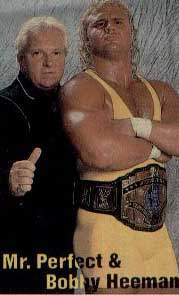
Aliases - Mr. Perfect Hometown - Robbinsdale, Minnesota Debuted - January 30, 1980 Titles Held - AWA World Heavyweight; AWA World Tag Team (with Scott Hall); FOW Heavyweight; i-Generation Heavyweight (2x); MECW Heavyweight; NWA Pacific Northwest Heavyweight; NWA Pacific Northwest Tag Team (3x; 1 with Larry Hennig, 1 with Buddy Rose, 1 with Pat McGhee); WCW United States; WCW World Tag Team (with Barry Windham); WWC Universal Heavyweight; WWF Intercontinental (2x) Other Accomplishments - Winner of PWI Most Improved Wrestler of the Year award in 1987; Winner of Wrestling Observer Newsletter Most Improved award in 1983; Ranked as #9 on the PWI 500 list in 1993; Inducted to WWE Hall of Fame in 2007
Curt Hennig was surrounded by the wrestling business from birth. Son of the legendary Larry “the Axe” Hennig, Curt was also surrounded by future wrestlers while still a student at Robbinsdale High School. Curt graduated with Dean Peters (WCW’s Brady Boone and All Japan’s Fire Cat), Tom Zenk, and Richard Roode (Rick Rude). In addition, Barry Darsow (Demolition Smash), John Nord (the Berserker), and Nikita Koloff were also attending the school.
After graduation, Curt headed to the University of Minnesota where he played on the football team. After a knee injury, he wound up consulting Verne Gagne for assistance with rehab.
In January of 1980, Cool Curt Hennig made his AWA debut. Hennig soon branched out. In the WWF, he wound up as an “enhancement talent” where he was also teamed with Eddie Gilbert regularly.
In 1982, Hennig headed to Don Owen’s Pacific Northwest territory. There he won his first gold on April 27, 1982 as he and his father Larry defeated Rip Oliver and Matt Borne to capture the territory’s tag team titles. The former champions reclaimed the belts on May 1, but it would be the first title of many.
Hennig’s first singles title win was in May of 1983 as he defeated Sheik Abdullah Ali Hassan to win the heavyweight title. He held this until September, when he was defeated by the Dynamite Kid.
Following his defeat by the Dynamite Kid, Hennig returned to the tag ranks where he and new partner Playboy Buddy Rose defeated Rip Oliver and the Assassin to begin his second reign as a tag team champion. Again, the reign was short – one week later they were defeated by the Dynamite Kid and the Assassin.
Hennig refused to accept defeat. He turned to another new partner in Pat McGhee and they claimed the gold on December 23. This time they held the titles until February when they were defeated by old foes the Assassin and Rip Oliver.
As 1984 dawned, Hennig returned to the AWA. He again tagged with his father and when Larry decided to step back from the ring, he was paired with another new partner named Scott Hall.
The pairing of Hennig and Hall worked and in January of 1986 they defeated Jimmy Garvin and Steve Regal to capture the AWA world tag team titles. They held them until May, when they were defeated by Buddy Rose and Doug Somers (who would shortly begin their legendary feud with the Midnight Rockers).
Hennig spent his time focusing on his singles career. Finally, at the second Superclash in 1987, Hennig reached the top of the mountain by defeating Nick Bockwinkel to claim the AWA world heavyweight title (with help from Larry Zbyszko and a roll of quarters). The belt was held up but Hennig did receive the title eleven days later.
Hennig was a dominant champion, holding the title for over a year. In May of 1988 he lost the title to Jerry Lawler at Superclash 3.
After losing the belt, Hennig headed East and signed with the World Wrestling Federation. Here he gained the moniker that he’s best known as today – Mr. Perfect. Videos were shot of him competing in various sports and showing how perfect he was at them by performing feats such as sinking a difficult putt, bowling a perfect game, and hitting a home run. In addition, real athletes were called in to “guest star” (such as Wade Boggs for the baseball video.
Once he debuted, Hennig would continue his dominance as he was undefeated for over a year. It was near the end of 1989 when the streak was broken. With the Genius as his manager, Perfect had begun feuding with Hulk Hogan. At Saturday Night’s Main Event Perfect escalated the feud to a new level as he stole Hogan’s world title belt, brought it backstage, and smashed it with a hammer.
Hogan repaid Hennig with Perfect’s first pinfall loss.
After losing to Brutus Beefcake at Wrestlemania VI, it was time for a change. The Genius was replaced by Bobby Heenan and Perfect captured the Intercontinental title in April by defeating Tito Santana in the finals of a tournament. (The title had been vacated after the Ultimate Warrior had defeated Hogan for the world title at Wrestlemania.)
During this time, Perfect continued to battle Hogan while he defended the IC belt from all comers. He held it until August, when he was defeated by the Texas Tornado (Kerry Von Erich) at Summerslam.
Perfect refused to let his gold go and recaptured it during a rematch in November. Perfect remained the champion in August of 1991 (with a little help from Ted DiBiase). He suffered a back injury during a match and agreed to Vince McMahon’s request that he wrestle one more match to drop the title. He did so on August 21 to Bret Hart.
While sidelined, Perfect found a new role. He became executive consultant to new WWF signee Ric Flair. Working with Flair’s manager Bobby Heenan, Perfect made sure that Flair won (and kept the belt). During this time Perfect was also working as a commentator.
However, problems erupted in 1992. After Hennig accepted an offer from Randy Savage to be on his team during the Survivor Series match, Bobby Heenan went ballistic on Prime Time Wrestling. After Heenan told Perfect he wasn’t at that level of wrestling anymore, he slapped Perfect in the face. Perfect responded by grabbing Heenan and emptying a pitcher of water over his head.
At Survivor Series, Perfect and Savage defeated Flair and Razor Ramon by disqualification.
Perfect continued his pursuit of Flair. At the 1993 Royal Rumble Perfect was responsible for Flair’s elimination. The next night he defeated Flair in a “loser leaves the WWF” match that sent Flair packing back to WCW.
Perfect soon found himself in a feud with Lex Luger that culminated at Wrestlemania. Luger defeated Perfect (although Perfect’s feet were in the ropes). After the match, Perfect chased Luger backstage and began attacking him only to get jumped by Shawn Michaels.
Perfect continued feuding with Michaels throughout the summer and finally defeated him at Summerslam (thanks to interference from Diesel). During this time Perfect and Bret Hart had also squared off again in the King of the Ring tournament in a match that saw Bret advancing.
Perfect vanished from the company soon thereafter.
Perfect returned for Wrestlemania the next year. He found himself as the guest referee for a match between Yokozuna and Luger. Yokozuna won after Hennig DQ’d Luger for putting his hands on him.
Shortly thereafter Perfect’s back problems became an issue once again and he again disappeared.
He returned again to his commentary role at the 1995 Survivor Series. After months of commentary, it was announced that Perfect would return to the ring in October of 1996. The night of the match Perfect was attacked backstage by Hunter Hearst Helmsley. Helmsley challenged Marc Mero for the Intercontinental title and won with help from Perfect.
Perfect began serving as Helmsley’s manager, but contract disputes with the WWF (reportedly over his insurance payouts for his back injury) led to Hennig leaving the company within weeks.
At the 1997 Bash at the Beach, Curt Hennig made his WCW debut as Diamond Dallas Page’s mystery partner against Randy Savage and Scott Hall. Hennig turned on Page and the two began feuding. The feud ended when Hennig defeated Page at August’s Road Wild.
While the Page feud was going on, Hennig was being heavily scouted by both the Four Horsemen and the New World Order. On August 25, Hennig was called out to the ring. Arn Anderson was announcing his retirement from in-ring competition and offered Hennig his spot in the Horsemen. As a tearful Ric Flair looked on, Hennig accepted and said that it would be an honor.
This led to Fall Brawl, where the Horsemen would face the nWo in a War Games match. The Horsemen were represented by Flair, Hennig, Chris Benoit, and Steve McMichael while the nWo representatives were Kevin Nash, Syxx, Buff Bagwell, and Konnan. During the match Hennig slammed the cage door closed on Flair’s head to end his affiliation with the Horsemen.
Hennig’s feud with the Horsemen only grew more heated as he defeated McMichael days later to capture the United States title. For months Hennig continued to defeat Ric Flair as the Nature Boy tried to take the belt from him. In addition, Hennig gained a manager – Rick Rude. Hennig finally lost the belt to Diamond Dallas Page at Starrcade.
When the nWo split, Hennig and Rude decided to ally themselves with Kevin Nash’s Wolfpac. However, Hennig suffered a knee injury and asked Konnan to replace him in a match at the Great American Bash against Goldberg. Konnan lost, so Hennig and Rude attacked him, switching sides to Hollywood Hogan’s nWo Hollywood in the process.
Hennig finally faced Goldberg at Bash at the Beach and lost. A loss to Dean Malenko followed at Fall Brawl.
During the year, Hennig’s knee injury had been growing steadily worse. In September, both Hennig and Rude were removed from television.
Hennig returned to TV alone at Starrcade, where he was instrumental in Eric Bischoff’s victory over Ric Flair. As thanks, he was almost immediately kicked out of the New World Order.
Hennig didn’t take long to rebound. He soon found himself paired with Barry Windham as a tag team. At Superbrawl in February, Hennig and Windham defeated Chris Benoit and Dean Malenko to win the WCW tag team titles. They lost the belts back to Benoit and Malenko the following month at Uncensored.
In June, Hennig returned to the spotlight as he, Windham, Kendall Windham, and Bobby Duncum Jr. joined forces to become the West Texas Rednecks. The Rednecks were assembled to feud with rapper Master P, who was intended to be the face in the feud.
The problem with the feud was that WCW had again misread their audience, who almost immediately tried to turn the Rednecks face while they booed Master P and his No Limit Soldiers. When the feud fizzled, WCW cut ties with Master P and started putting the Rednecks into feuds with the Horsemen, Harlem Heat, and the Filthy Animals. WCW also added another member to the group – Curly Bill (AKA Vincent AKA Virgil AKA Mr. Jones).
After the Rednecks broke up, Hennig soon found himself feuding with Shawn Stasiak. Stasiak was now calling himself “Perfect-Shawn” and was coming out to a knockoff of the old Mr. Perfect theme. Stasiak won the feud and Hennig began coaching him before leaving WCW in mid-2000.
After WCW shut down Hennig joined Jimmy Hart’s X Wrestling Federation. He participated in the XWF’s tapings, even facing Hulk Hogan in what Hogan felt could be his last match. The XWF almost immediately fizzled out.
In 2002, the WWF began announcing that Mr. Perfect would return at the Royal Rumble. True to the promises, Hennig returned as Perfect and was one of the last three combatants. Although the appearance was intended as a one-night deal, Hennig’s stellar performance combined with the red-hot crowd convinced the WWF to offer him a full contract.
Hennig’s stay did not last long as he was released in May following an overseas tour.
In October, Hennig made his debut for NWA-TNA by pinning NWA World champion Ron Killings in his debut match. Hennig chased Killings for a few more weeks before he found himself in a feud with Jeff Jarrett.
Again, Hennig’s stay would be cut short as he passed away on February 10, 2003 at the age of 44.
In 2007, Hennig was inducted into the WWE Hall of Fame. In addition, Hennig’s son Joe and daughter Amy are both currently training to become wrestlers like their father.
Although his list of titles is surprisingly short, Curt Hennig’s contributions to wrestling cannot be understated. He held the AWA world title for over a year and was one of the company’s shining stars at that time. While he held the Intercontinental title, it was during a time in the WWF’s history that the IC belt went to the best all-round worker in the company. Hennig has been praised by wrestlers such as Bret Hart and Ric Flair as one of the greatest wrestlers who ever lived.
But Hennig’s talent wasn’t only in the ring. He was also excellent on the microphone. This not only served him well while working in the ring, but also allowed him to make the transition to commentating when his physical condition wouldn’t allow him to compete.
Hennig was a true all-rounder, who has definitely more than earned his place in this list of the top 100 wrestlers of the modern era.
Quote:
12. THE UNDERTAKER
Real Name - Mark Calaway Aliases - Kane the Undertaker; The Punisher; Mean Mark Callous; Texas Red; The Commando; Punisher Dice Morgan; Master of Pain Hometown - Austin, Texas Debuted - 1984 Titles Held - USWA Unified World; WCWA Texas Heavyweight; WCW Tag Team (with Kane); WWF/WWE Championship (4x); WWF Hardcore; WWF Tag Team (6x - 1 with Stone Cold Steve Austin, 2 with the Big Show, 1 with the Rock, 2 with Kane); WWE World Heavyweight (2x) Other Accomplishments - Winner of 2007 Royal Rumble; Sixteen year undefeated streak at Wrestlemania; Winner of PWI Feud of the Year award in 1991 (vs. Ultimate Warrior); Winner of PWI Match of the Year award in 1998 (vs. Mankind - Hell in a Cell); Ranked #2 in the PWI 500 in 2002; Winner of Wrestling Observer Newsletter Best Gimmick Award from 1990-1994; Winner of Wrestling Observer Newsletter Best Heel award in 1994; Winner of Wrestling Observer Newsletter Feud of the Year award in 2007 (vs. Batista); Winner of Wrestling Observer Newsletter Most Overrated award in 2001; Winner of Wrestling Observer Newsletter Readers’ Least Favorite Wrestler award in 2001; Winner of Worst Worked Match award in 2001 (with Kane vs. Kronik); Inducted into the Wrestling Observer Newsletter Hall of Fame in 2004
In that regard he stands in a class all alone. All of his peers have their share of detractors. Hogan has been called untalented and egomaniacal. Flair has been painted as a “belt mark” and a backstabber. Michaels and Hart are labeled whiners and crybabies. Triple H is accused of marrying into his success. Goldberg and Warrior were thought to be only in it for the money. Austin is ridiculed for taking his ball and going home when things didn’t go his way. The Rock is chastised for not “giving back to the industry.” Yet the Undertaker has seen them all come and go. He’s stood tall through all the changes over the better part of the past two decades, and has lived to tell a magnificent story.
His career started like so many of his contemporaries in the 1980s. He earned his stripes working through the regional territories of the day, primarily in Texas and Tennessee, under a variety of gimmicks like Texas Red, The Punisher and The Master of Pain. He eventually hit the “big time” at the very end of the decade when he joined WCW under the guise of “Mean” Mark Callous and replaced an injured Sid Vicious as one of The Skyscrapers until Danny Spivey left the company. He then paired up with Paul E. Dangerously as the token mid-card heavyweight “jobber to the stars,” not unlike what we see out of someone like Mark Henry or Snitsky today. His most notable match was a loss to United States Champion Lex Luger at Great American Bash ’90, while his only notable victories came over smaller men like Flyn’ Brian and Johnny Ace. (As a side note, look back at a match between Mark Callous and Johnny Ace with Paul E. Dangerously on the outside, and just try to comprehend the heights all three of those men have risen to in the industry. It’s something no one could have predicted.)
Unfortunately his pale skin and shock of red hair didn’t exactly give him the look of a main event superstar, and WCW didn’t really know what to do with him. They released him in September 1990, but he wouldn’t remain unemployed long.
When “Million $ Man” Ted DiBiase began touting a mystery partner for his “Million $ Team” at Survivor Series ’90 no one really knew what to expect. It was an era where the Internet was nonexistent and word didn’t really spread all that fast in regards to wrestling news. A young mark (much like me) couldn’t see beyond the logical choices of Dustin Rhodes, Virgil or Randy Savage. Needless to say no could have expected what we got with The Undertaker. In his initial match he captivated the audience in a way so few ever have. His look, style and mannerisms immediately made him stand out from the rest of the roster. Despite what seemed like a hokey, one-note, supernatural, dead guy gimmick, he caught on with fans and management alike, and he hasn’t looked back since. It is mind boggling to think that his upper-mid card to main event push started immediately upon his debut and really hasn’t subsided once in over seventeen years.
Without getting into a blow-by-blow recap of the man’s storied career, it’s easy to see that his stats are truly remarkable.
His now unrivaled WrestleMania unbeaten record started humbly by defeating “Superfly” Jimmy Snuka in a throwaway match on the undercard of WrestleMania VII. That streak has now extended to 16-0, with victories over all four principal members of Evolution, three World Championship victories and two legit show-closing main events.
His reputation as the “giant killer” or “beast slayer” has found him in truly abysmal matches with far less talented super heavyweight lugs like Kamala, Giant Gonzalez, King Kong Bundy, Yokozuna, King Mabel, Sid, Heidenreich, Mark Henry, The Great Khali, and others that have been blocked from memory. Yet somehow he’s come out of every one of those rivalries with his integrity and credibility in tact.
He has also endured some of the most ridiculous and over-the-top stunts ever pulled by WWE, including the infamous ten-on-one Casket match beat down from Royal Rumble ’94, the fake Undertaker bit from later that year, tying Steve Austin to his “symbol” in 1999 and of course burying his own “father” Paul Bearer in cement in 2004. And that is without getting into the entire twisted logic of that whole Paul Bearer-Kane-Undertaker family story.
What makes him so special is the versatility that he has shown with the character. The Undertaker gimmick could have easily turned into a cheese ball, Wrestlecrap-worthy waste if not for the work put into keeping it relevant in WWE’s constantly changing climate. The character has transformed from an Old West style mortician, into the purple “Phantom of the Opera” mask phase of ’95, to gothic Undertaker in ’96, and then into the Lord of Darkness as the leader of the Ministry. In 2000 he went through a complete overhaul when he became the motorcycle driving American Bad Ass. He finally came back full circle when he returned to his roots as the Texas dead man in 2004. This latest stage, which has been around since WrestleMania XX, has allowed him to incorporated little bits of all of his previous characterizations into a completely evolved character that allows him to still go “old school” while incorporated new MMA based offense into his arsenal.
Yet through all of the character changes, all of the bad angles and all of the super heavyweight brawls, the man has remained at the top of the industry. He has been in main events since 1991 and even to this day is considered one of the company’s remaining true remaining draws. He has worked with, and beat, every big thing that has come through the doors of WWE. Everyone from Hulk Hogan, Shawn Michaels, Bret Hart, Kevin Nash, Steve Austin, The Rock, Triple H, Ric Flair, Brock Lesnar, Kurt Angle, Vince McMahon himself and his greatest rivals Kane and Mankind have fallen at the feet of Undertaker.
His character has been responsible for some of the more memorable gimmick matches in the company’s history, ranging from the Buried Alive match and the Last Ride match to the more famous casket match and Hell in a Cell. He’s been a six-time World Champion, picked up seven Tag championships and even got the old Hardcore Championship one time yet has never been defined by the Championships he has won or lost. He’s won the Royal Rumble, the Elimination Chamber, and really has nothing else to prove in that department.
It’s really remarkable to think that Undertaker has already been around for close to two decades. The ability to constant re-invent himself as well as his new part time schedule constantly keeps him fresh in the fans’ eyes. His longevity within the company is unparalleled, and other than a violent crime against society I don’t picture a world where Undertaker and WWE aren’t linked in some way. When Ric Flair received his hero’s farewell back in April, people wondered if there would ever be a career celebration like that again. And in my mind you can count on one hand the number of others who are deserving of such accolades. Undertaker is one of those who is certainly deserving of it, but don’t expect him to be standing there blubbering in the middle of ring, expect him to go like he came in: quiet and with a purpose.