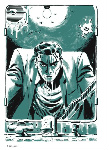
This weekend, I have mostly been watching "In Search Of Steve Ditko," the upcoming BBC4 programme where Jonathan Ross goes in search of his comics artistic hero.
Jonathan Ross is a national institution in the UK. In the mold of David Letterman, he has created a number of chat show formats, as well as introducing Britain to Vic Reeves and Bob Mortimer, whose influence in British comedy would dominate the nineties. He's a regular participant of "Comic Relief," a weekly BBC Radio 2 show, the host of the BBC's weekly film review show and the recipient of an £18 million deal over five years at the BBC. Which he has spent mostly on comics. He used to own a comic shop in Soho, London called Top Ten, is the biggest single customer of comics in the UK and owns a number of copies of "Amazing Fantasy" #15.
American comic geeks probably know him best for kissing Neil Gaiman at the Eisners this year.
So what better man to introduce Britain, especially the snobby arty types like me who watch BBC4, to Steve Ditko?
And he does an admirable job. With comics fan BBC Radio DJ Paul Gambaccinni and Mark Millar both enthusing over Jonathan's collection (Mark discovering the only way to get a word past Paul is to be filmed on a separate camera), Ross plots Ditko's career and influence, talking to Cat Yronwode, Flo Steinberg, Joe Quesada, John Romita Sr., Joseph Rubenstein and many more. Ross even shows a clip from the bloodthirsty Turkish Spider-Man TV show. And Alan Moore recited his Steve Ditko song lyrics.
And Ross paints a man of mystery of strange genius, of peculiar politics who came to Marvel, left his mark and then left, never being truly acknowledged for his influence. Annoyingly it cuts out Ditko's return to Marvel with projects such as "Machine Man" and "Speedball," seemingly because it spoils the narrative being painted.
But amazingly, Ross does something with Stan Lee that I've never seen on camera. He presses the point over Stan's acknowledgement of Steve Ditko as co-creator of Spider-Man and for about twenty seconds, Stan drops the mask. The huckster, the showman, the face-front of Marvel is gone and you see the true man behind... before the mask comes back up again. For someone who's been brought up on Stan Lee, hell I even interviewed him myself twelve years ago, it's incredibly unsettling and worth the whole programme.
And then Ross, hand in hand with Neil Gaiman, goes stalking Steve Ditko across New York City, giving anyone else who wishes to do the same all the information they need. Do they succeed? Well, that's presumably one of the reasons you'll want to watch the show.
It's a bizarre show, both Ditko/Comics 101 for a general audience, but also exploring some of the myths and legends that genuinely have grown up around Ditko, with an incredibly enjoyable presenter who means every word he says.
The show airs on BBC4 on September 18th at 9:30pm for 60 minutes. Odds are it'll be on YouTube the day after. Set your Sky Plus boxes... now!
I'd really like to see this. especially to see Stan Lee drop his constant carnival act and be real, even if just for a moment.
So, why did Dabel Bros. Studios and Marvel part ways?
I understand it was basically over repeated non-payment to creators. Marvel had to cover a variety of payments and, as stated in the contract, in such circumstances, the contract was cancelled and Marvel ended up with the rights to a number of series which they'll continue to publish.
This is good news for Marvel. Not only do they get to be the good guys, but they also gain the "Anita Blake" series which just netted them the #1 best selling graphic novel this month - and that's only in the direct market.
I understand that there were other issues concerning operating budgets and schedule dates. But it was the non-payment that threatened to really blow up in their faces and there was real fear at Marvel that the non-payment story might all come out in this very column before they had a chance to fix it.
So they fixed it.
Les Dabel tells me "I'm not sure where you got this information from. The conclusions they've drawn are inaccurate.
"This was a business decision, not some case of 'good guys' and 'bad guys' as you suggest. We parted ways with Marvel on good terms and we are looking to continue what we do best -- to bring as many new faces as we can into the industry."
I would like to clarify I spoke to creators who feel stiffed by the Dabel's and individuals at Marvel Comics who are very clear about having to pick up Dabel's tab on a number of projects.
If anyone out there has anything to add, now is the time to do it.
I wonder if Jimmy Bott got stiffed by them.
So, who is the next writer of "Legion" after Tony Bedard? One blogger has been told one name. "Jim."
Lee or Shooter? Both have a strong interest in the title.
Well, as reported, the new "Legion" artist is Francis Manapul, whose inker is John Livesay, who is working on a project... with Jim Shooter.
and all the Shooter and Legion fans rejoice.
Tony Harris' next project, is a comic book series set in the 1940s and written with B Clay Moore.
and Grimm rejoices!
Bendis on Ultimate Spider-Man's legacy:
"It invented a more reader-friendly comic book. Even though it's 120 issues, you read that recap page, which by the way didn't exist in ancient comics prior to Ultimate Spider-Man. That was a Bill Jemas invention. The new writers don't want to bog down the writing with exposition, which is just lazy writing. So to do a recap like they do in front of 'Law & Order,' or 'Previously on ER,' to do that and get back right into the story. So that has now been applied to every comic book."
A Bill Jemas invention indeed, and one that appeared in "Nexus," "Bone," "Flaming Carrot," "Astro City," all the Milestone books, Penthouse Comix, "Deadpool"... and then pretty much every Marvel comic in the mid nineties, sporting a fold out cover recap page with an ad on the back, all before Jemas had editorial power.
"a jemas invention."

he's not your boss anymore, Bendis, you can stop sucking up to him.