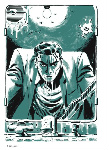
CCI: You worked in animation for a number of years including at Warner Bros. Animation. What's it like going full circle and coming back to work on New Frontier?
Darwyn: It was pretty weird, in a good way. It's been probably seven years since I worked with the guys at Warners' and I still have a lot of friends there. My time there was great and I got to know so many of the guys who ended up working on The New Frontier, so it was like old home week. It was a lot of fun.
CCI: New Frontier is an epic work. How much of it will we see translated to the movie version and how difficult was it to let some of the story go?
Darwyn: It's like a lot of things: it feels a lot worse than it is at first. We were all pretty daunted by trying to compress this material down to a 70-minute video. But Stan Berkowitz did a great job of objectively going through the story and finding out what needed to stay and what could go. The screenplay he pulled together did a very good job of that, so it was just a matter of us playing with it a bit more. It was really kind of difficult and hard to let go, but in the end we were all pretty amazed at how much of the story actually made it into the video and how much does feel like the book.
CCI: New Frontier is very much of a particular era, the late 1940s through the 50s. Is that maintained in the movie?
Darwyn: We certainly did our best and there were some hilarious moments when the prop designers were designing things like pink telephones from 1959. So yeah, we had notes for them (laughs) but all in all the entire crew really embraced the challenge of trying to put that together. And our partners overseas will let us know if we've succeeded or not, but what we tried to do with it is not to use any techniques that will make it clear that this was made after 1955. We want it to feel like it was made with the resources and technology available at the time. Granted we are using digital to support what we're doing everywhere we can, but we want it to look traditional.
So in everything from the color palette on down, I think we've done pretty good in scoring it. I did design most of the characters so I was able to control the wardrobe and things like that. I think we got it. I mean, until you see the footage you just don't know.
CCI: New Frontier included a lot of history and social issues. Will we see that transferred to the movie?
Darwyn: Again, we were in a tough spot because we had to cut so much material. But its incredible how much we've managed to maintain. It's in short bursts, but we're using devices like Batman looking through an old style microfilm catalogue, so we get these slides that roll by with Rosa Parks, or the Russians, and all this kind of material that we've used as much as we can for backstory. And I really think it all comes through pretty clearly.
CCI: The new DVD films are not beholden to the continuity that's on, say, the Justice League TV series.
Darwyn: If they had been adapting this in the "Adventures" style that would have been great. But the fact that this was going to get to stand alone is what made it really exciting, and that they wanted it to look like the book is like, "Wow, what a great opportunity."
followed by one with Paul Levitz.
Quote:
CCI: DC has had a long history of turning their characters into animated properties. There's been a consistent animated presence on TV since the early 90s. Now you've entered the arena of direct to DVD movies. What does this kind of format offer for you, storytelling wise, and why now?
Paul: I'd argue our animation history really goes back unbroken to the mid 60s when you had the New Superman and Aquaman stuff air. Because there really hasn't been more than a year, maybe a two-year gap at any point, when we didn't have new animation on the air. iI's a pretty amazing run, so we've got a long history of loving it.
I think what's different now, with direct to video, is you walk away from the "this is for little kids only" label. We have a lot of history in animation going back at least to Batman The Animated Series in the early 90s of shows that attracted significant adult audiences and got great receptions from them because they simultaneously worked for kids and for adults. But the direct to video form for the first time really allows you to do that consciously rather than just the creative people kind of sneaking it through.
The other thing that changes in the process (is) because you're not advertising supported but you're entirely customer supported, you get a real orientation of what it is people most want to watch. How do you identify that, how do you track that back, and how do you deliver to them? And with out audience, that leads us logically to the conclusion that what they would like to watch are our classic stories, our important stories, done in ways that are faithful to the comics material themselves.
CCI: Part of the allure of the series of new films is its basis in classic DC stories yet, Superman Doomsday, the first film was very different than it's comic book source material. Are these stories just jumping-off points for the movies or will we see more faithful adaptations in the future?
Paul: I think it will very much vary project by project. Doomsday was kind of a bridge project. It had been started in development before we came to all of the conclusions from a marketing standpoint that we're now operating with. But it seems to have met a great reception in its first couple of weeks in the marketplace as well as the reception it had sort of face to face when we premiered it in San Diego. First of all, I think you have to look at the story itself. "The Death Of Superman" story is so lengthy, so complex in its twists and turns because of how it was originally told (with) literally hundreds and hundreds of pages of comics material. There were a lot of barriers in doing that as a faithful literal adaptation, no matter what you did.
So I think it was a very intelligent decision to do something, I think your phrase was "used it as a jumping-off point" I think that's a very fair description for it. We started from the source material and said, "Okay, how would we tell this story for this medium?"
New Frontier is a case where the body of the material is more structured to be a single story. It wasn't about doing periodical comics with a kind of "Perils of Pauline" moment intrinsic to it the way "Death of Superman" had been. So it was a little easier to look at that and see how true to the thing we can get this to be. We still have to make a lot of changes to make it suitable for the medium. it wasn't written to be an hour-long animation, it was written to be a 200-page comic, but I think it's a lot closer to the source.
CCI: Superman Doomsday was an epic story told by people in its original comics presentation. New Frontier is also an epic story but it's the vision of one creator Darwyn Cooke paying tribute to the comics he loved as a kid. How true to his story is the final film?
Paul: I think everyone will have a slightly different opinion of that. For Darwyn, that's an enormously emotional question because there are little moments that mattered a tremendous amount to him that either got picked up or didn't as the structure changed. For those of us who loved the original and have had a chance to see this, I think we feel it is very, very true to the spirit and the magic of the original, and the visual style has a tremendous relationship to Darwyn's style of drawing the comic.
Nonetheless it's a different thing. It has to be somewhat different thing for it to succeed on its own terms.
CCI: It was announced that Darwyn is currently working on a comics sequel to New Frontier. Will this come out around the same time as the DVD movie?
Paul: I don't know about the timing. I'm not really in the loop for that but I know he and Dan Didio have started conversations about a next project in the New Frontier timeline.
CCI: Comic-Con hosted the world premier of Superman Doomsday in July. WonderCon will do the same for Justice League in February. How important are these convention screenings for you?
Paul: I think it's a great moment. When I went out there at Comic-Con to introduce Superman Doomsday and you had, I think, over 4,000 people in Ballroom 20, that's an enormously infectious moment. If you've got something that works, that's a tremendous group of people to get caught up in the fire of it and get the word out.
One of the challenges you have with direct to video as a medium is that its sold through a wide variety of retailers who are not deeply focused on this as a product. It's not like taking a movie DVD of a 200-million-dollar hit film and rolling it through the retailer. It's a brand new product each time by definition. And you really want to create a motivated group of people to go out and buy it the first couple of weeks to create the retail momentum to demonstrate success in order to get the right placement for the line on a continuing basis and to keep the thing rolling. And for that you obviously do a number of different things, including the Comic-Con or WonderCon events, but that certainly seems to have worked with Superman Doomsday and I think the convention (premiere) was a meaningful part of that.