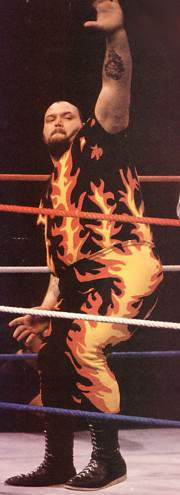
Real Name - Scott Bigelow Aliases - Bruce Bigelow; Crusher Yurkof; The Beast from the East Hometown - Asbury Park, New Jersey Debuted - August 23, 1985 Titles Held - AWA Southern Heavyweight; ECW World Heavyweight; ECW World Television; NWA Northeast Heavyweight; IWGP Tag Team (with Big Van Vader); USA Heavyweight; UXW Pro Heavyweight; WCW Hardcore; WCW World Tag Team (2x - with Diamond Dallas Page and Kanyon); WCCW Television; WAR World Six-Man Tag Team (with Hiromichi Fuyuki and Youji Anjoh) Other Accomplishments - Ranked #68 of the 500 Best Singles Wrestlers of the PWI Years by Pro Wrestling Illustrated; Ranked #36 of the 100 Best Tag Teams of the PWI Years by Pro Wrestling Illustrated (with Big Van Vader); Winner of Wrestling Observer Newsletter 1986 Rookie of the Year award
It’s become more than a cliché in wrestling that if a super heavyweight can so much as leave his feet for more than a second, the announcers will rail about how “he can really move for a big man.” Sometimes it’s earned, but more often than not the hype just amounts to Big Daddy V dropping an elbow. However, when it came to Bam Bam Bigelow, the “Beast from the East” more than lived up to the hype.
In his heyday, Andre the Giant could throw a mean dropkick, but when he entered the wrestling business in the late 80’s, Bam Bam Bigelow redefined what it meant to be an agile big man. At well over 300 pounds, Bigelow had the athleticism to bust out moonsaults and cartwheels while keeping pace with the likes of Bret Hart and other world class technicians over the course of his career.
With his physical tools and a unique look capped off by his signature tattoo-covered bald head, many feel Bammer never went as far as he should have, but over the course of a distinguished 20 year career, Bigelow earned a place as of the top one hundred wrestlers of the modern era more than once.
Scott Bigelow trained to be a wrestler under veteran Larry Sharpe in his native New Jersey and spent less than two years on the U.S. independent circuit and in Japan before debuting on the huge national stage of the World Wrestling Federation in 1987 as Bam Bam Bigelow. Vince McMahon and the WWF had enough confidence in the relative rookie that they built to his first television appearance with weeks of vignettes that saw every heel manager in the fed claiming to have signed Bigelow. When BBB did make the scene, it was as a babyface under the guidance of Oliver Humperdink. In his first pay-per-view appearance at the 1987 Survivor Series, Bigelow outlasted every member of his team, including captain and World champion Hulk Hogan, before being eliminated by Andre.
Bigelow burned out the year in mid-card feuds with the likes of Nikolai Volkoff, but injured his knee in early 1988 just as he was beginning to build a fan following. He worked through his injury in a loss to One Man Gang in the first round of a tournament for the vacant World championship at Wrestlemania IV.
For whatever reason, following Wrestlemania IV, Bam Bam Bigelow disappeared from the WWF. Too much pressure from being pushed too hard too fast for an inexperienced grappler? An ill-timed early injury? Though the world may never know why Bigelow left, many wrote him off as being unable to handle the big time less than a few years into his professional career. After making only a handful of appearances in the National Wrestling Alliance, challenging for Barry Windham’s U.S. title, Bigelow scurried back to Japan, seeming destined to become one for the “Could Have Been” file as far as North American wrestling.
Over the next three years, as part of Antonio Inoki’s New Japan Pro Wrestling, Bigelow improved his in-ring skills, toughened his mental attitude and formed a dominant tag team with Big Van Vader. After Vader left Japan to dominate World Championship Wrestling in 1992, Bigelow followed his lead, returning to the WWF near the end of the year.
While Bam Bam’s return to the WWF may not have been as heralded as his initial foray into the federation five years prior, the slower burn seemed to work for the big man, as he quickly found a comfortable niche as an upper mid-card heel. After defeating the Big Boss Man at the 1993 Royal Rumble, Bigelow became a frequent house show foil for World champion Bret Hart, who would later cite the “Beast” as one of his all-time favorite opponents. The two would meet on pay-per-view in the finals of the King of the Ring tournament in June, and while Bigelow lost, it cemented him as a legitimate star and skilled worker.
In the summer of 1993, Bigelow picked up veteran women’s wrestler Luna Vachon as his valet and “main squeeze.” While the duo found themselves embroiled in a comedy feud with Doink the Clown and his midget sidekick Dink for the rest of the year and well into 1994 culminating at Wrestlemania X—where Bigelow and Vachon won a mixed tag match—they proved entertaining when given an opportunity for more microphone time, allowing Bam Bam to demonstrate talent beyond the ring.
After a series of matches with Tatanka in early 1994, Bigelow dropped Luna and joined Ted DiBiase’s Million Dollar Corporation stable. While he wasn’t receiving many opportunities at either the World or Intercontinental titles, Bam Bam had demonstrated that his rookie burnout was a fluke and became one of Vince McMahon’s most reliable talents, able to consistently deliver good matches and make his opponents look good in the process. While he may not have been the star of the show, Bigelow was one of the key role players during a rebuilding period for the WWF.
1995 proved to be the most important year of Bam Bam Bigelow’s career, providing him with a wealth of exposure, though arguably at the expense of some of his credibility as a legitimate competitor. Following a loss in a tag match at the Royal Rumble, Bigelow endured taunting from football legend and ringside bystander Lawrence Taylor. When LT got in Bam Bam’s face, the embarrassed brawler shoved back, igniting a feud that would culminate at Wrestlemania XI and bringing the WWF mainstream publicity and notoriety it had lost in the years leading up. With Bigelow leading the gridiron great through the paces, the two put on arguably the best wrestling match involving a non-wrestler ever, and in the end, Bam Bam went down to a Taylor flying shoulder.
While the Wrestlemania match with Taylor had raised Bigelow’s profile in the eyes of casual fans, the more hardcore WWF fan base had trouble seeing the “Beast” as a legitimate threat to the likes of Hart and new World champion Diesel when he couldn’t even beat a football player. Bigelow was turfed from the Million Dollar Corporation and experienced a mild push as a babyface, but despite growing fan support, a combination of backstage politics and McMahon running out of idea for him led Bam Bam to depart the WWF a second time in late 1995.
Over the next two years, Bigelow went into something of a semi-retirement, surfacing occasionally in the Philadelphia-based Extreme Championship Wrestling to feud with the likes of Taz and Terry Gordy, while also embarking on an unsuccessful shoot fighting venture in Japan.
Bam Bam began working with ECW on a more regular basis in mid-1997, joining Shane Douglas and Chris Candido in the heel Triple Threat stable. In the fall, Bigelow turned on Douglas and defeated him for the ECW World title, the most significant singles championship he had ever held. While Bigelow would lose the belt back to Douglas in a brutal encounter the next month at the November to Remember pay-per-view, his reign made it clear that he was considered a main event competitor in ECW, a promotion considered on the cutting edge in North America.
ECW treated Bigelow as a respected and formidable veteran who posed a danger to every wrestler in the promotion, rehabilitating much of the damage the loss to Lawrence Taylor had done to his career. In 1998, Bam Bam rejoined the Triple Threat and renewed his old feud with Taz, defeating him for the ECW Television title in match that saw both men crash through the ring. Soon after, Bigelow would lose the belt to Rob Van Dam, helping to establish RVD’s star, and then put Taz over in a series of vicious brawls over the summer, cementing his burgeoning legend as well.
Having helped establish ECW and its key players, Bigelow departed the promotion at the end of 1998, heading to WCW where he would ride out his career. After an initial push into a feud with the red hot Goldberg, the “Beast from the East” settled into the mid-card, where he would win the WCW World Tag Team and Hardcore titles on multiple occasions, forming alliances with Diamond Dallas Page and Chris Kanyon while feuding with the likes of Brian Knobbs, Mike Awesome and more.
Bigelow rode out 2000 and 2001 as more of a special attraction than a key player for WCW, appearing occasionally because he could still pop the crowd, but never again having a true meaningful role in the promotion. In the final days of WCW prior to its sale to Vince McMahon in 2001, Bigelow had one final feud with Shawn Stasiak and then faded once more into semi-retirement rather than negotiate an unlikely WWF return.
After a few years of occasional returns on the independent circuit, Bigelow quietly retired in 2006. Sadly, he would pass away a year later from a drug overdose at the too-young age of 45.
While he may never have been able to remain at a sustained main event level in the WWF or WCW in his prime, Bam Bam Bigelow remains an important contributor to professional wrestling, be it through his redefinition of the agile super heavyweight, his high profile match with Lawrence Taylor, his key roles in rebuilding the WWF in the mid-90’s and building ECW in the late-90’s, or all of the above.
and a truly tragic end for the Slammy winner.
Quote:
45. OWEN HART
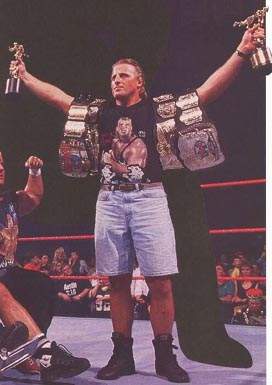
Aliases Owen James; The Blue Blazer; The Rocket; The King of Harts Hometown Calgary, Alberta Canada Debut May 30, 1986 Titles Held IWGP Junior Heavyweight; Stampede British Commonwealth Mid-Heavyweight; Stampede North American Heavyweight (2x); Stampede International Tag Team (with Ben Bassarab); USWA Unified World; WWF European; WWF Tag Team (4x - 2x with Yokozuna, 1 with British Bulldog, 1 with Jeff Jarrett; WWF Intercontinental (2x) Other Accomplishments Winner of PWI Rookie of the Year Award in 1987; Back-to-Back Winner of Wrestling Observer Best Flying Awards in 1987 & 1988; Winner of PWI Feud of the Year Award in 1994 (vs. Bret Hart); Winner of Wrestling Observer Feud of the Year Award in 1997 (Hart Foundation vs. Steve Austin); Recipient of PWI Editor’s Award in 1999; Ranked as #66 of the 500 Best Singles Wrestlers During the PWI Years; Ranked as #84 of the 100 Best Tag Teams of the PWI Years (with Davey Boy Smith); Member of Stampede Wrestling Hall of Fame
He was the crown prince of Calgary.
Owen Hart grew up into wrestling royalty. He was the youngest of twelve children, all of whom ended up having some sort of ties to the wrestling business. Despite being the youngest, Owen Hart may very well have been the best in-ring athlete of the entire bunch, and that’s no knock on his brother Bret.
Like the rest of his brethren, Owen started out in his father’s infamous “Dungeon” training facility and then began working for the family’s Stampede Wrestling in Calgary. He naturally worked his up through the family promotion thanks to his flashy, high-flying style.
His skills got him noticed worldwide. He picked up the 1987 PWI Rookie of the Year award and soon headed off to New Japan Pro Wrestling. He was instant success in the Orient, and picked up the prestigious IWGP Jr. Heavyweight Championship quickly. Owen was the first gajin to hold that belt and one of only two Canadians to this day who has earned it.
After his stint in Japan he ended up the World Wrestling Federation. It was in 1989 after his father had sold the Calgary territory to McMahon. His older brother Bret was already an established performer in the WWF at this time so he came in under the masked superhero gimmick The Blue Blazer, so as to not cause confusion or storyline explanation. His unique look and style made him popular with fans but he just didn’t fit with the mold of the top card guys at the time, and he disappeared midway through 1989.
In late ’91, after dropping the Blazer mask to Canek in a mask for mask bout in Mexico, Owen returned to the WWF. He was paired with his brother’s old tag partner Jim Neidhart as The New Foundation. Following the dismissal of Neidhart and a brief singles run, Owen joined up with fellow high-flier Koko B. Ware as High Energy. The pair teamed for the better part of a year before Owen went solo, as “The Rocket.” His relationship with brother Bret, who was now a top star in the WWF, was played up more and they became part-time tag partners.
It was in 1994 when Owen finally turned on his big brother that his star began to rise. Owen played the jealous little brother role to perfection. After pinning Bret clean at WrestleMania X, the pair embarked on months long family feud over the WWF Championship. They put on a tremendous steel cage main event at SummerSlam ’94 and continued their rivalry through 1994. This run against Bret really put Owen on the map as a legitimate superstar finally out of his brother’s shadow.
In 1995 Owen picked up the WWF Tag Championship with Yokozuna and hired Jim Cornette as his manager. Throughout ’95 and ’96 he worked alongside Yoko, brother-in-law Davey Boy Smith and Vader as part of Cornette’s stable. Owen and Davey Boy picked up the WWF Tag Championships in late ’96 and ruled a weak tag division.
But his greatest run came in 1997. He and Davey Boy had started a mini-feud over the fledgling European Championship, but were reunited together by brother Bret. Together that trio, along with Jim Neidhart and Brian Pillman, formed a new Hart Foundation. Owen also picked up the Intercontinental Championship along the way. The group’s status was unheard of at the time as they were clear-cut heels to American audiences, but were wildly popular and over as faces around the rest of the world and especially in Canada.
During this time Owen had a feud with Steve Austin that led to the now infamous SummerSlam ’97 match where Hart dropped Austin on his head during a botched piledriver attempt. Austin’s neck was badly damaged, and that injury actually ended being the catalyst for a lot of changes in the WWF in the future.
After his brother Bret’s “Screwjob” at Survivor Series ’97, Owen became the remaining Hart family representative in the WWF. He adopted “The Black Hart” and then later “The Lone Hart” persona to reflect the changes around him. He went into a feud with Hunter Hearst-Helmsley that transitioned into a DeGeneration X-Nation of Domination feud when Triple H took over leadership of DX and Owen joined The Nation.
After The Nation dissolved, Owen worked with Ken Shamrock and then Dan Severn. They worked an angle with Severn where Owen “injured” Severn, playing off his real injury against Austin a year earlier. This led to Owen “quitting” the WWF and The Blue Blazer returning in his place. The Blazer angle also coincided with Owen “returning” and forming a successful tag team with Jeff Jarrett. The pair, loosely known as “Canadian Country,” won the WWF Tag Championships during their time together.
It was ultimately this comedy angle with The Blue Blazer that led to Owen’s very unfunny demise.
As Owen Hart was preparing to lower from the rafters of the Kemper Arena on May 23, 1999, in preparation for an Intercontinental Championship match against The Godfather he fell 78 feet into the ring. He died right there in the ring during the unfortunately titled “Over the Edge” pay per view.
Owen was only 34 years old when he passed away. He left behind a lot of family and friends that really knew him, but also left behind a void for wrestling fans that only knew him through his work in the ring. His career was become a major case of “what if” for many fans, including yours truly.
As a quick editorial statement I would like to say that to this day, of all the premature wrestling deaths that have happened over the years, his is the one that has affected me the most.
He came from wrestling royalty and died well before his time. His story seems like something found in a Greek tragedy or something. And as a professional he was one of the best. In the ring he was phenomenal as an aerial artist, scientific technician, and he could hold his own in a brawl. He was decent on the mic, but had a wicked sense of humor that helped his in-ring characters. He was the type of in-ring talent that any promoter would dream to have under their employ.