|
living in 1962 15000+ posts
Joined: Jun 2002
Posts: 19,546 Likes: 1 |
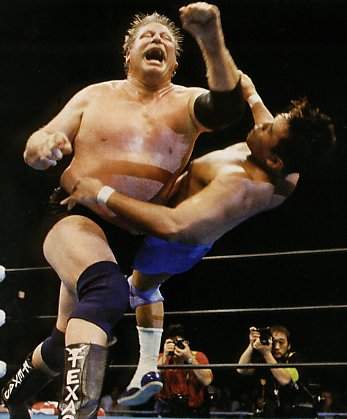 35. STAN HANSEN
Hometown - Borger, Texas
Debuted - 1973
Retired - 2000
Titles Held - AJPW Triple Crown; AJPW Unified World Tag Team (8x – 2 with Terry Gordy, 3 with Genichiro Tenryu, 1 with Dan Spivey, 1 with Ted DiBiase, 1 with Gary Albright); AWA World Heavyweight; NWA United States; NWA World Tag Team (with Ole Anderson); NWA International Heavyweight; NWA International Tag Team (with Ron Bass); NWA United National; PWF World Heavyweight (4x); PWF World Tag Team (4x, 1 with Bruiser Brody, 2 with Ted DiBiase, 1 with Austin Idol); CWA International Heavyweight; NWA Columbus Heavyweight; NWA Georgia Heavyweight (2x); NWA Georgia Tag Team (3x – 2 with Tommy Rich, 1 with Ole Anderson); NWF Heavyweight; NWA Texas Tag Team (with Killer Tim Brooks)
Other Accomplishments - First PWF World Tag Team champions (with Bruiser Brody); Wrestling Observer Hall of Fame Class
of 1996; renowned for his stiff style; retired due to
lower back pain; Winner of All Japan’s Champion’s Carnival in 1992 and 1993; Winner of All Japan’s World’s Strongest Tag Team League in 1983 (with Bruiser Brody), 1985 (with Ted DiBiase), 1988 (with Terry Gordy), and 1989 (with Genichiro Tenryu); Winner of PWI’s Match of the Year Award in 1976 (vs. Bruno Sammartino); Winner of PWI’s Most Hated Wrestler of the Year Award in 1976; Winner of Wrestling Observer Newsletter’s Tag Team of the Year Award in 1982 (with Ole Anderson); Winner of Wrestling Observer Newsletter’s Brawler of the Year Award in 1985 and 1990; Ranked as #16 of the Best 500 Wrestlers During the PWI Years by Pro Wrestling Illustrated; Ranked as #7 (with Bruiser Brody), #24 (with Ted DiBiase), #34 (with Terry Gordy) and #66 (with Ole Anderson) of the 100 Best Tag Teams During the PWI Years by Pro Wrestling Illustrated
Stan Hansen started wrestling in 1973 for the local promotion in Amarillo, Texas. However, it was only a side job as he also played professional football for the Detroit Wheels, which were part of the World Football League. The Wheels, however, were only in existence for part of the 1974 season. After fourteen games (and racking up a 1-13 record), the team folded and Hansen began wrestling full-time. The World Football League itself shut down operations during the 1975 season.
1974 saw Hansen also competing for Leroy McGuirk’s Tri-State company, which operated in Texas, Oklahoma, and Arkansas. This stint is notable because this is where Hansen first teamed with Bruiser Brody. This is also where Hansen won his first titles. In October of 1974 Hansen and Brody defeated Johnny Eagles and Terry Lathan to win the Tri-State versions of the NWA United States Tag Team titles. They held them until the following July, when Danny Hodge and Jay Clayton defeated them for the belts.
Early 1976 also saw Hansen and Killer Tim Brooks win the NWA Big Time Texas Tag Team titles (in 1982, Big Time Wrestling would have its name changed to World Class Championship Wrestling). March 3 saw Jose Lothario and Rocky Johnson taking the belts away.
Hansen also began competing in Vincent J. McMahon’s World Wide Wrestling Federation. It was here that Hansen gained a great deal of infamy. During a match with champion Bruno Sammartino on April 26, 1976, Hansen broke Sammartino’s neck. It was announced that it had been Hansen’s Lariat finisher that had done the deed, but in reality it was a botched bodyslam.
Fearing a disastrous gate for the Antonio Inoki/Muhammad Ali match they would be showing in June, McMahon got Sammartino back for a rematch on the same card. (The Inoki/Ali match would be shown on closed-circuit television, and in the WWWF territories, WWWF matches would make up the undercard.) Sammartino won by count out when Hansen fled the ring, and McMahon’s decision was backed up by the fact that the Inoki/Ali match drew poorly, but the Hansen/Sammartino match drew huge crowds.
Hansen’s next stop was Mid-South Wrestling. In May of 1977, Hansen defeated Dick Murdoch to win the Mid-South North American title. He held the belt for about a month before he lost it to Bill Watts.
From there Hansen headed to Georgia Championship Wrestling. He and Tommy Rich soon defeated the Minnesota Wrecking Crew of Ole and Gene Anderson to win the NWA Georgia Tag Team titles, but they closed 1977 by losing them to Ole Anderson and Jacques Goulet.
Hansen wasn’t too bothered. Also in December of 1977, he defeated Dick Slater to capture the NWA Georgia Heavyweight title. Although Mr. Wrestling defeated him to win it soon into the new year, February saw Hansen regain the belt and finally vacate it. At the same time he vacated that title, he also defeated Abdullah the Butcher to win the NWA Columbus Heavyweight title, which he lost later soon thereafter.
During this time, Hansen was also gaining fame in the Orient by competing for New Japan Pro Wrestling. In 1981, he jumped to All-Japan Pro Wrestling, the primary company he would remain with for the rest of his career.
1983 saw Hansen competing in Memphis for the CWA and feuding with Austin Idol. Hansen defeated Idol to capture the International Heavyweight title in September (only two days after Idol had won the belt himself) and lost it back to Idol in a bull rope match on October 3.
In December of 1985, Hansen won the AWA World Heavyweight title by defeating Rick Martel. The match was unusual in that Hansen won by using a backbreaker submission hold. Because Martel submitted, the loss greatly hurt Martel’s standing in the fans’ eyes.
Hansen proved to be a dominant champion going into 1986 by defeating challengers such as Nick Bockwinkel, Leon White (who would later become known as Vader), and Jerry Blackwell. However, there was one force that Hansen could not defeat – and that was wrestling politics.
On June 29, 1986, Hansen arrived for a title defense against Bockwinkel and Verne Gagne informed him that he’d be losing the belt. Hansen contacted All-Japan’s Giant Baba to get the okay to lose the belt, and Baba, who had already been scheduling championship matches of his own, refused. Hansen refused to lose the title, so he was not sent out and Bockwinkel won the match (and the title) after Hansen was announced as a no-show.
Hansen took the belt and headed back to Japan, where he was still promoted as the AWA champion. Bockwinkel was given a tag team title belt that was announced as the world title.
Gagne and the AWA soon contacted Hansen and threatened legal action if Hansen continued keeping the belt (which was AWA property) and promoting himself as the champion. Hansen replied by running over the title belt in his pickup truck and mailing it back to Gagne. (Years later, at an NWA Legends convention, Hansen did express regret for his actions.)
In 1990, Hansen returned to the United States and began feuding with Lex Luger over the NWA United States title. However, as the company began morphing into WCW, problems arose.
The issue was that WCW debuted a stable called the Desperadoes composed of Dutch Mantell, Black Bart, and Deadeye Dick (Moondog Rex). The three would wander around old western sets and get into “hilarious” hijinks as they searched for Hansen.
Hansen was mortified. He immediately left the company and returned to Japan. (Without Hansen, the Desperadoes fizzled out by the end of the year.) Hansen never again competed in the United States.
In 2000, after suffering from severe back pain, Hansen wrestled Genichiro Tenryu during a tournament to crown a new All-Japan Triple Crown champion. The company was suffering as several of All-Japan’s top stars had quit the company to form Pro Wrestling NOAH. Kenta Kobashi’s departure had vacated the title. Hansen lost the match and Tenryu would wind up winning the tournament and the title. That match was Hansen’s last.
In 2001, Hansen became the head of All-Japan’s Pacific Wrestling Federation, which is the governing body for the All-Japan titles. He resigned in 2007 and was replaced by Hiroshi Hase.
Stan Hansen was the perfect example of a monster heel. He was legitimately tough and almost impossible to defeat, as if he was the champion, he had no problems with taking a loss by DQ. Hansen’s Lariat also became a feared finisher following the incident with Sammartino in 1976.
Although Hansen had long periods of time when he didn’t compete in the United States, he still made an impact during the periods when he was present. Although Hansen has been retired for almost a decade now, his legend lives on. I was never a big Hansen fan, so to me this is too high a placement. I remember his US title feud with Luger, but the thing that stood out more was him blowing a snotrocket out after the match. heh. he was also in that crapfest No Holds Barred, which should drop him at least another twenty slots. 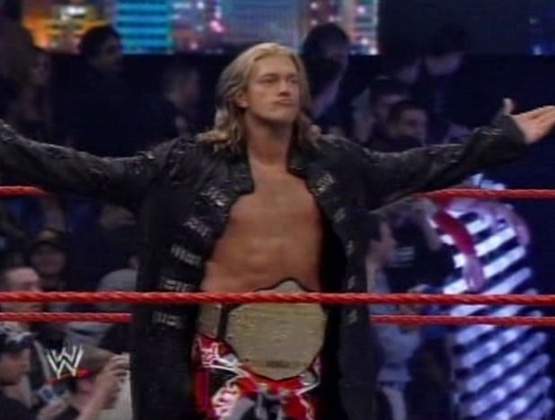 34. EDGE
Real Name - Adam Copeland
Aliases - Adam Impact; Damon Striker; Sexton Hardcastle
Hometown - Orangeville, Ontario
Debuted - July 1, 1992
Titles Held - ICW/MWCW Mid-West Unified Tag Team (with Psycho Joe Sampson); ICW Streetfight Tag Team (2x, with Christian Cage); OCW Tag Team (with Psycho Joe Sampson); SSW Tag Team (with Christian Cage); WCW United States; WWE Championship (2x); WWE Tag Team (with Rey Mysterio); WWF/WWE Intercontinental (5x); WWF/WWE World Tag Team (11x - 7 with Christian, 2 with Chris Benoit, 1 with Hulk Hogan, 1 with Randy Orton); WWE World Heavyweight (2x)
Other Accomplishments - 2001 WWF King of the Ring Winner; 2005 Money in the Bank winner; WWF/WWE Triple Crown winner; Ranked #2 in the PWI Top 500 list in 2007
It doesn’t always happen that a young boy knows what he wants to do with his life; follows through on those dreams and becomes successful in his chosen profession.
“Edge” Adam Copeland was one of those men. From sitting in the crowd at WrestleMania VI as a kid to being voted “most likely to be WWF Champion” in his high school yearbook, Edge was destined to become a professional wrestling superstar.
He got his start in 1992 after winning an essay contest that allowed for the winner to be granted free wrestling training. He spent his early years paying his dues on the Canadian and northeastern United States independent circuit. He worked with others who would all go on to be famous as well, including Joe E. Legend, Rhino, Don Callis and his childhood friend Christian Cage. He worked primarily under the moniker Sexton Hardcastle and formed successful teams with Legend and Cage under a variety of team names.
His big break came in 1998 when he was signed to the World Wrestling Federation. He had everything Vince McMahon looks for in a star; he was tall, well built and had a full head of hair. He debuted in the summer of 1998 as the loner character named Edge, and was immediately thrust into a feud with fellow newcomer Gangrel. After a few months of battling, Edge’s old buddy Christian was introduced to the mix as Edge’s brother. The trio of Edge, Christian and Gangrel soon began teaming together as the Brood, a take-off on the young Goth lifestyle. They also worked as foot soldiers in the larger Ministry of Darkness stable put together by The Undertaker.
By the end of 1999, Edge and Christian broke away from The Ministry and split from Gangrel. They were put into a hot feud with fellow young lions Matt & Jeff Hardy over the managerial services of Terri Runnels. A tag team ladder match in October 1999 put all four men on the map as budding superstars.
At WrestleMania 2000, Edge & Christian, along with The Hardys and The Dudley Boyz redefined WWF tag team wrestling with their three team ladder match. In that match Edge and Christian won their first of seven WWF Tag Championships.
For all of 2000 and the first half of 2001 it was the “E & C Dynasty” as Edge and Christian ruled the WWF tag team and mid-card scene. Their talent in the ring, their backstage and comedy antics and their legendary rivalry with Matt & Jeff Hardy made the duo huge successes.
Edge finally got his first real taste of singles success by winning the 2001 King of the Ring tournament. Later in the summer he picked up the Intercontinental Championship from Lance Storm and embarked on a blood feud with “brother” Christian after Christian turned on him. When the InVasion angle ended at Survivor Series 2001 Edge walked out as the unified Intercontinental and United States Champion, and was a bonafide rising singles star at this point.
When the initial brand expansion happened in 2002, Edge was one of the top stars sent to SmackDown! He was thrust into a star-making feud with Kurt Angle and got to win the World Tag Championship with his childhood idol Hulk Hogan. Then in the fall of 2002 he teamed with Rey Mysterio and mixed it up with Eddie & Chavo Guerrero, Kurt Angle & Chris Benoit in the legendary “SmackDown! Six” rivalry over the WWE Tag Championship.
He suffered a severe neck injury in early 2003 and was out of action for over a year. He returned in April 2004 as part of the RAW brand. He won the Intercontinental Championship from Randy Orton and had a pair of World Tag Title reigns with Chris Benoit, but his real passion was winning the World Heavyweight Tile. He turned heel in late 2004 and went on a streak of solid matches with Shawn Michaels, Chris Jericho and Shawn Michaels en route to winning the initial Money in the Bank ladder match at WrestleMania 21.
By this time his real-life tryst with Amy “Lita” Dumas had been made public thanks to Matt Hardy, who was released by WWE during the turmoil. The crowds immediately turned the pair into the company’s biggest heels. The worked a romance angle with Kane, who was Lita’s storyline husband before Hardy was rehired by the company and the backstage feud was turned into a on-air worked-shoot angle. Edge ended up coming out the better of the two in their feud, looking like the bigger star in the process.
He finally reached the upper plateau in January 2006 when he cashed in his Money in the Bank World Title shot and pinned John Cena to win the WWE Championship immediately after Cena survived an Elimination Chamber match. Edge and Lita’s post-win “live sex celebration” on RAW earned the show its highest ratings in over a year. Weeks later Edge dropped the belt back to Cena. He then transitioned into a feud with Mick Foley that culminated in a hardcore match victory for Edge at WrestleMania 22.
Edge then headed back into the WWE Title picture, picking up the belt again in June 2006 from Rob Van Dam. He and Cena feuded over the belt through the summer and fall of 2006 before Cena won the belt back. Edge then went into a team with Randy Orton to feud with Shawn Michaels & Triple H.
His next big break was in May 2007 when he got the Money in the Bank title shot from an injured Mr. Kennedy and used it to beat Undertaker for the World Heavyweight Championship after Undertaker had just wrestled a cage match. Edge was Champion for two months before going out with a pectoral injury.
He returned in at Survivor Series 2007 and picked up the World Heavyweight Championship a second time a month later at Armageddon.
Edge is currently positioned as the top heel on SmackDown! He is in a “relationship” with SD! General Manager Vickie Guerrero and has a loose working stable with Chavo Guerrero and Kurt Hawkins & Zach Ryder.
He is currently at the top of his game, riding in the prime of his career. Even if he goes out tomorrow with a career-ending injury the man has already had a more successful career than most professional wrestlers can dream about. He’s been working for the biggest wrestling company in the world for a solid decade straight now. He has won four World Championships, a dozen World Tag Titles and countless secondary titles.
Critics will say much of his recent success has become because of sleeping around his friend’s woman, but that’s only a small part of it. Edge had the looks, skills and intangibles that would have made him a star regardless. He just used the negatives of one situation and turned them into a positive. He’s just a lifelong fan who actually got the chance to do exactly what he wanted with his life. Can’t fault the guy for that.  33. HARLEY RACE
Aliases - Jack Long
Hometown - Eldon, Missouri
Debuted - 1960
Titles Held - NWA United National; NWA World Heavyweight (8x); PWF Heavyweight; AWA World Tag Team (5x – 4 with Larry Hennig, 1 with Chris Markoff); NWA Central States Heavyweight (9x); NWA Florida Southern Heavyweight; NWA Florida Tag Team (3x – 2 with Roger Kirby, 1 with Bob Roop; NWA United States Heavyweight (Mid-Atlantic); IW North American Heavyweight; NWA Georgia Heavyweight; IWA World Tag Team (with Larry Hennig); NWA Mid-America Heavyweight (3x); NWA Missouri Heavyweight (7x); Stampede North American Heavyweight; WWA World Heavyweight; WWC Caribbean Heavyweight; 1986 WWF King of the Ring
Other Accomplishments - Winner of PWI Match of the Year award in 1973 (vs. Dory Funk Jr.); Winner of PWI Match of the Year award in 1979 (vs. Dusty Rhodes); Winner of PWI Wrestler of the Year award in 1979; Back-to-Back Winner of Wrestling Observer Newsletter Wrestler of the Year award in 1980 and 1981; Winner of PWI Match of the Year award in 1983 (vs. Ric Flair); Winner of Wrestling Observer Newsletter Match of the Year award in 1983 (vs. Ric Flair); Winner of PWI Wrestler of the Year award in 1983; Ranked by PWI as #8 of the top 500 singles wrestlers during the PWI years; Member of WCW Hall of Fame (inducted 1994); Member of the Ring Chronicle Hall of Fame (inducted 1994); Member of the Wrestling Observer Newsletter Hall of Fame (inducted 1996) Member of the WWE Hall of Fame (inducted 2004); Member of the Professional Wrestling Hall of Fame (inducted 2004); Recipient of Cauliflower Alley Iron Mike Mazurki award in 2006; Recipient of PWI Stanley Weston award in 2006; Member of the Stampede Wrestling Hall of Fame
Harley Race began training after he was expelled from high school following an incident when the principal had kneed Race in the back of a head while trying to break up a fight and Race attacked him. He trained under Gus Karras, a promoter in St. Joseph.
In 1961 Race headed to Nashville and began competing under the name of Jack Long, who was teamed with his “brother” James Long. His talent was beginning to be recognized until a car accident. Race’s pregnant wife was killed and doctors planned to amputate one of Race’s legs. It was Gus Karras who rushed to the hospital to protest the operation and save Race’s leg. Despite this, the doctors told Race he would likely never walk again and would certainly never wrestle again.
Race refused to accept this and attacked physical therapy with a vengeance, eventually regaining full use of the leg. In 1964 he returned to action in Amarillo, Texas where he worked for the Funk family. This time, however, he was competing under his own name after a visit from his father during his recovery. His father had advised Race not to work to make somebody else’s name famous. Race competed under his own name for the rest of his career.
While in Amarillo, Race met another young wrestler- Larry Hennig. The two joined up as a tag team and headed to the AWA, where they became known as Handsome Harley Race and Pretty Boy Larry Hennig.
Race and Hennig defeated perennial AWA stars the Crusher and Dick the Bruiser on January 30, 1965 to capture the tag team titles. The Crusher vowed revenge and allied with Verne Gagne to recapture the belts on July 24. They held the belts for barely a month before Race and Hennig regained them. The following May, Crusher turned back to Dick the Bruiser and won the belts back. This time it took until January for Race and Hennig to regain the gold.
There was an interesting title switch in March. Gagne and Don Leo Jonathan won the belts in Winnipeg but the change was not recognized by the AWA outside the city. The belts were soon returned to Race and Hennig.
In November Race began defending the belts with Chris Markoff. Hennig, needing time off from the ring, had had his leg broken by Gagne during a match in Winnipeg. On November 10, 1967 Race’s final AWA tag team reign came to an end when he and Markoff were defeated in their first defense by Pat O’Connor and Wilbur Snyder.
Race left the AWA soon thereafter and began traveling from territory to territory, including a return to Amarillo.
The return to Amarillo also saw one of Race’s darkest days. While wrestling Man Mountain Mike on July 2, 1969, Iron Mike DiBiase (stepfather of Ted DiBiase) collapsed during the match. Race realized that DiBiase was having a heart attack and rushed to the ring where he performed CPR on DiBiase. Race then rode to the hospital with DiBiase, where he was pronounced dead.
Race spent the next several years traveling the territories and racking up numerous regional title wins, but a world title shot still evaded him.
That changed one May night in 1973. Race had been given a title shot against NWA World Heavyweight champion Dory Funk, Jr. Although he went into the match an underdog, Race fought with all he had and walked out of the match as the new world heavyweight champion. Although Race lost the belt to Jack Brisco in July, he had established himself as a definite contender.
Race continued to travel the territories, earning title after title but still found himself without a title shot. Still, Race vowed that all he would need would be one opportunity to regain the belt.
Race’s shot came in February of 1977 as he faced off against longtime foe Terry Funk. Race won the match by submission, an unusual ending, after he locked Funk (who had a wounded leg) in an Indian Deathlock.
Race immediately established himself as a fighting champion, defending the belt up to six times a week. Race dominated the title for the next four years. Although he lost the belt to Dusty Rhodes in 1979, Giant Baba in 1979 and 1980, and Tommy Rich in 1981, Race always regained the belt in a rematch, with none of those listed above holding the belt for more than ten days before Race took it back.
Race became the standard bearer for the NWA. He had become a familiar face on Japanese tours early in his career and continued touring extensively there as well as in Australia and New Zealand. In addition, Race often found himself defending the NWA title against WWF champion Bob Backlund and AWA champ Nick Bockwinkel in matches that would always end indecisively.
In June of 1981 Race’s reign came to an end as he lost the belt to Dusty Rhodes. Race would try repeatedly but would never be able to dethrone the American Dream.
Still, Race was not finished. Although he couldn’t take the belt from Dusty Rhodes, Dusty’s successor – Ric Flair – would be a different matter. Race defeated Flair on June 10 to regain the title for a record-setting seventh time.
However, Flair wanted a rematch. In response, Race offered a $25,000 bounty to anyone who could injure Flair and force his retirement. Dick Slater and Bob Orton Jr. took up the challenge and injured Flair’s neck. Race gladly paid them the money after Flair announced his retirement.
However, it was a trick. Flair returned and the title rematch was set as the main event of the 1983 Starrcade. The match would take place inside a steel cage and would feature Gene Kiniski as the special guest referee. In this match, all of Race’s tricks didn’t help as Flair regained the title at the end of the bloody bout.
Race would have one more unusual title reign. During a match in New Zealand in March of 1984 Race regained the belt only to lose it back to Flair two days later in Singapore. While the change received heavy coverage in Japan it was ignored in the US.
After losing the title a final time, Race began moving toward retirement. He had long before begun investing in promotion ownership and by this point owned part of the Kansas City and St. Louis promotions.
Unfortunately for Race, St. Louis was seen as one of the most prestigious NWA territories, so it was at the top of the list when Vince McMahon began his national expansion. When St. Louis closed, Race reportedly lost over $500,000. Kansas City was later sold to Jim Crockett and Race found himself forced to continue wrestling to make ends meet.
After competing for various regional and Japanese territories, Race signed with the WWF in 1986. He was brought in as Handsome Harley Race and given Bobby Heenan as a manager.
However, the Handsome nickname would not last long. Race won the inaugural King of the Ring tournament and immediately proclaimed himself King Harley Race. He began coming to the ring in a cape and crown. After a match, the loser would be prompted to kneel before him.
Over the next few years Race would feud with the Junkyard Dog, Hacksaw Jim Duggan, and Hulk Hogan himself. It would actually be Hogan who would indirectly be involved in the end of Race’s WWF career. Race was trying to hit a diving headbutt on Hogan, who was lying on a table. Hogan rolled out of the way and Race went through the table, with the metal rim of the table being rammed into Race’s abdomen, causing a severe hernia.
While Race recovered from hernia surgery, the WWF moved on. Heenan announced plans to crown a new King and did so with Haku. Race briefly feuded with Haku but wound up leaving the WWF shortly thereafter.
Race continued to wrestle in various territories until mid-1991 when he finally retired from the ring. Although no longer wrestling, he was quickly picked up by WCW to serve as a manager to first Lex Luger, and then, more famously, to the monster Vader.
A second car accident spelled the end of Race’s career. As a result of the accident, Race required a hip replacement. That combined with the other wear and tear he had suffered over his career caused Race to decide to retire.
Although Race has continued to make occasional onscreen appearances for WCW, the WWE, and TNA, today his primary focus is on his own promotion – World League Wrestling. Race founded WLW in 1999 and opened a training school a year later. His school is well regarded, having produced current WWE star Trevor Murdoch and being the chosen site for children of veterans like Ted DiBiase and Curt Hennig to begin their training. WLW also has close ties with Pro-Wrestling NOAH in Japan, which allows his trainees to interact with various Japanese stars (including Mitsuharu Misawa and Takeshi Morishima, a former WLW champion), and also provides a possible route for his graduates to begin touring in Japan as well.
Harley Race is one of the most respected names in all of wrestling. Although his career was winding down by the 1980 guideline for this countdown, he still continues to work in the wrestling business to this day. As a matter of fact, Race has claimed in interview that he does believe he has one more match left in him.
Race had a stellar thirty-year career as a wrestler, and then stepped aside to manage two of WCW’s biggest superstars. When he was no longer able to manage, he soon opened his own company, once again working behind the scenes and also passing along his knowledge to a new generation of professional wrestlers.
Race is the definition of a professional wrestler. He fought the odds his entire career and, while losing some fights along the way, he won far more than he lost. Race is a star who will always be remembered and has more than earned his position on this list of the top 100 greatest wrestlers of the modern era. a definite legend. he should be further up the list.
|